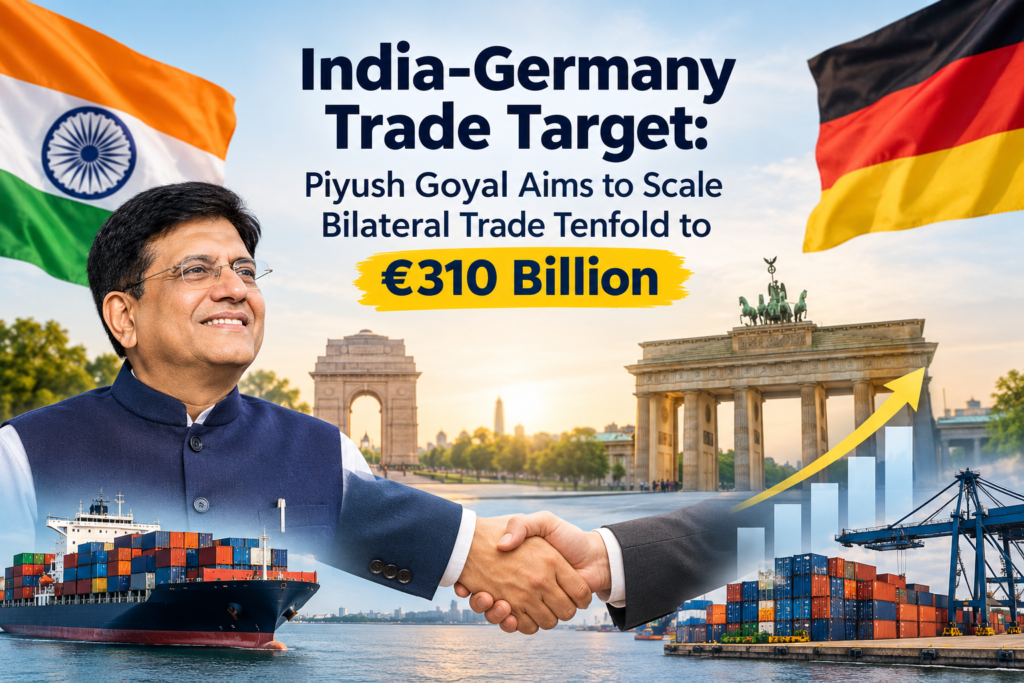
India-Germany Trade Target: Piyush Goyal Aims to Scale Bilateral Trade Tenfold to €310 Billion
Union Commerce and Industry Minister Piyush Goyal announced India’s trade target with Germany at the Berlin Global Dialogue. He proposed raising bilateral trade from about €31.5 billion to €310 billion.
The push comes as the India-EU free trade agreement nears signing. Goyal wants businesses to be ready before it takes effect. His idea is simple: “Add a zero” to current trade. He believes German engineering and Indian talent can make it happen.
The announcement came during the Berlin Global Dialogue and an India-Germany Business Roundtable. Goyal urged businesses to focus on complementary strengths, technology co-creation, manufacturing, investment, and resilient supply chains.
But is this goal realistic? Read on to see which sectors could lead the way.
What Led to the €310 Billion Target?
Piyush Goyal proposed the €310 billion goal during high-level engagements in Berlin on October 22, 2026. He met German Federal Minister Katherina Reiche, addressed the India-Germany Business Roundtable, and participated in the Berlin Global Dialogue.
India and Germany already share strong investment ties across various domains, including industry and technology. Yet India-Germany bilateral trade stands at only about €31 billion, quite below its actual potential.
Goyal believes cooperation can go much further. The upcoming India-EU free trade agreement can improve market access and create new trade and investment opportunities. The €310 billion figure is an ambition, not a signed commitment or guaranteed outcome.
Why Goyal Wants to “Add a Zero”
India-Germany trade is about €31 billion today. Goyal asked a simple question. Why should future plans follow past statistics? He said trade relations should move beyond conventional imports and exports. He urged both countries to co-create products and technologies rather than focus only on “Made in India” or “Made in Germany. That’s where he inserted the hook: India’s invention of zero.
If trade adds a zero, it jumps from €31.5 billion to €310 billion. A whopping tenfold increase. He also pointed to global trade forecasts. Growth estimates for this year rose from 1.9% to about 3%-3.5%. And in this remarkable Diamond Jubilee moment of 75 years of diplomatic ties between India and Germany, it’s really a time to think bigger.
Goyal says the €310 billion trade target isn’t a normal speech. He really likes to turn this simple discussion into an actionable plan. That is why he brought a 100-member delegation to Berlin. Trust, innovation, research, and joint value creation are central to this 10x bilateral trade approach. The target is a long-term ambition. It has no fixed deadline.
Which Sectors Can Drive the 10X Growth?
Piyush Goyal trade announcements named several priorities for deeper cooperation. Some areas can typically support higher-value trade and larger export volumes. That means more joint production and shared technology. Both countries just need to put focus on these key areas to strengthen them. Let’s learn about these spheres:
Area | Opportunity |
Manufacturing | Joint production, precision engineering and industrial supply chains |
Technology | Digital technologies, research collaboration and innovation partnerships |
Investment | More German investment in India and Indian expansion in Germany |
Infrastructure | Transport, energy, urban development and industrial infrastructure |
Skills | Industry-academia partnerships and workforce development |
Goyal also stressed economic security, green transition and apprenticeships.
He said German precision engineering, India’s infrastructure, digital capabilities, and skilled workforce can shape a strong future.
What It Means for Indian and German Businesses
Undoubtedly, this €310 billion trade target could spur more business opportunities between the two countries, signaling a shift from one-off trade deals to long-term industrial cooperation. But how? Let’s understand:
- Joint Ventures & Tech Transfers: Stronger India-Germany trade relations could bring more joint ventures and technology transfers. This could strengthen supply-chain partnerships between the two countries. Investment flows may also rise, which would help both sides build long-term industrial links and shared capabilities over time.
- Gains for Indian Firms: Indian exporters and startups could gain broader access to German markets. Mostly those in technology and Fintech. Skilled professionals can easily find more opportunities when India-Germany bilateral trade deepens.
- Openings for German Firms: German companies can explore India’s growing consumer and digital markets. Businesses that identify sector-specific opportunities can build long-term partnerships.
Challenges to Achieving the Target
The India-Germany trade target faces practical hurdles. Both sides have enough to address, so implementing this plan in reality is really difficult. Let’s check out why:
- Regulatory alignment: Indian and German firms operate under different legal and tax systems. Clearer rules and mutual recognition can reduce delays and make cross-border business easier, but all these procedures are little time-consuming. Maybe that’s why Mr Goyal kept this journey without a fixed deadline.
- Market access: Companies may face entry barriers in licensing, distribution, procurement, and local partnerships. Faster approvals and transparent processes in India and Germany are indispensable for expanding trade and investment, even if they take time.
- Compliance costs: Goyal has raised concerns that the EU’s carbon border mechanism could raise costs and weaken competitiveness. Meeting the India-Germany trade target will need policy clarity, faster approvals, and sustained business engagement from both countries, especially for MSMEs and resource-constrained exporters.
- Sustained execution: Achieving the €310 billion ambition will require policy clarity, faster approvals, and sustained business engagement. Only continuous engagement between governments and businesses can achieve this long-term goal.
Is €310 Billion Realistic?
Germany’s Economy Minister Katherina Reiche has suggested doubling trade and cutting red tape. That is far more modest than a tenfold rise. Goyal himself called the €310 billion goal “very, very bold” and left the plan to businesses.
Reaching 10x bilateral trade will depend on the India-EU FTA taking effect on schedule. Goyal expects signing by December and implementation within four to five months. Faster approvals will also matter.
Until then, the outcome remains uncertain. Watch for the FTA signing and any business-led plans.
Follow us for more updates on this context.
A Junior Journalist passionate about reporting accurate, engaging, and reader-focused news across technology, business, education, health, entertainment, lifestyle, and current affairs. Dedicated to researching reliable sources, verifying information, and producing clear, factual content that follows ethical journalism standards.