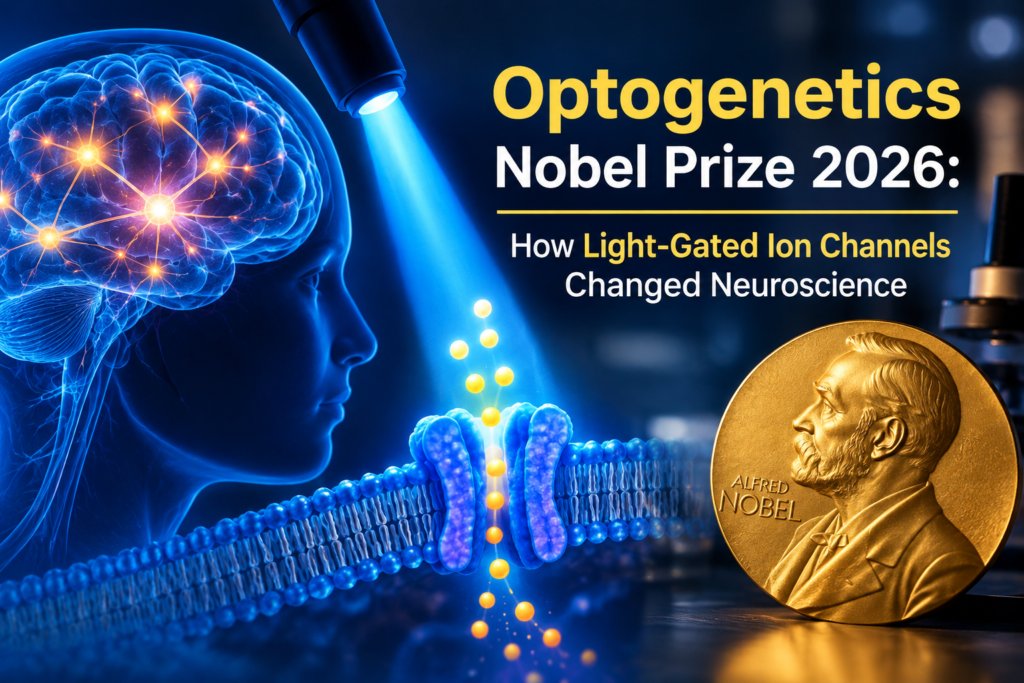
Optogenetics Nobel Prize 2026: How Light-Gated Ion Channels Changed Neuroscience
Science has long sought precise control over brain activity. The optogenetics Nobel Prize 2026 recognizes a breakthrough that turned this dream into reality.
Researchers can now activate or silence specific neurons using light, opening new frontiers in understanding and treating brain disorders.
On 5 October 2026, Karl Deisseroth, Peter Hegemann and Georg Nagel won the Nobel Prize in Physiology or Medicine for their discoveries on light-gated ion channels and optogenetics. Their method reveals how nerve cells shape memories, feelings and behaviors in the living brain.
But the story doesn’t begin in a neuroscience lab. It begins with a tiny alga swimming toward the light. How did we get from there to here?
The Problem Before Optogenetics
The journey wasn’t easy. Why? Here are the reasons:
Tangled Human Brain
The human brain holds roughly
86 billion neurons, and these cells are not neatly sorted. Different types sit side by side, and their wiring runs in every direction. Neuroscientists wanted to know what each type does, but the brain offers few clues about which cells drive which behaviors.
Limited Tools for Neural Control
Earlier methods like
electrical stimulation lacked cell-type specificity. Drugs acted too slowly and affected broad brain regions. Scientists needed a faster, more targeted approach to study neural circuits in living animals. Optogenetics emerged as a revolutionary solution, offering light-based precision to control specific neurons.
The Need for Precision
Understanding behavior requires manipulating defined neuron populations with millisecond accuracy. Existing techniques could not achieve this level of spatial and temporal control simultaneously. This gap motivated the search for a genetic “switch.” The key to this precision lies in
light-gated ion channels, which let researchers turn specific neurons on or off with light on millisecond timescales.
Crick’s Challenge
In 1979, Nobel laureate
Francis Crick named this problem in print. He argued that neuroscience needed a way to control one type of neuron while leaving all the others alone, and he speculated that light might be the ideal tool because it can be delivered in precisely timed pulses.
At the time, however, no one knew how to make neurons respond to light. This challenge helped define the future of
neurotechnology, a field that would later combine genetic targeting with optical control to manipulate neural activity with high precision.
How Optogenetics Closed the Gap
Optogenetics delivered what Crick had imagined by combining two ideas:
- Genetics provides selectivity: researchers insert the gene for a light-sensitive protein, such as channelrhodopsin, into only the chosen cell type, so only those cells respond to light.
- Light provides speed and precision, as a pulse delivered through a thin optical fiber opens the channels within milliseconds, and when the light stops, the response stops.
Together, these tools let researchers map neural circuits with unprecedented accuracy, switching specific neurons on or off at exact moments in a living animal and observing effects on memory, movement, or behavior.
Discovery of Light-Gated Ion Channels
The key paper came from his lab in 2005. It showed that expressing algal channelrhodopsin-2 in cultured mammalian neurons allowed millisecond-timescale control of action potentials with flashes of blue light. The same report says the lab made the switch work in living mouse brains two years later.
The basic recipe
1. GENE DELIVERY → 2. LIGHT → 3. RECORD
Put the opsin gene Shine light Measure neural activity
into chosen cells on the cells and behavior
- Deliver the gene. In the 2005 study, the team used lentiviral gene delivery to get channelrhodopsin-2 into neurons.
- Deliver light. The same study paired this with high-speed optical switching to stimulate the neurons.
- Record the effect. The researchers showed reliable control of neuronal spiking and excitatory and inhibitory synaptic transmission.
Why Genes Give Cell-Type Specificity
Only cells that receive the gene make the light-sensitive protein, so only those cells respond to light. This approach allows genetic targeting, which is why researchers can probe specific neuron subclasses. Channelrhodopsin-2 also worked without adding synthetic chemicals to the cells.
Expanding the toolkit
Channelrhodopsin-2 turns neurons on, so researchers looked for a way to turn them off. Han and Boyden reported that halorhodopsin, a light-driven chloride pump, could silence genetically specified neurons with pulses of yellow light.
Using blue and yellow light together lets them drive both activation and silencing in the same neurons. Later work added more options, such as
archaerhodopsin-3, which silences neurons in response to yellow or green light.
What Is Optogenetics?
Optogenetics merges genetic targeting with optical control. Scientists introduce genes for light-sensitive proteins into specific neurons, then use light to activate or inhibit those cells with high precision.
This approach represents a major advance in neural engineering, blending tools from genetics, optics, and neuroscience into a single experimental platform.
How It Works in Practice
Light-gated ion channels open or close in response to specific wavelengths. This alters the neuron’s electrical state, triggering or suppressing signals. The process is rapid, reversible, and highly cell-type specific, relying on channelrhodopsin’s unique properties as a light-activated switch.
Why This Discovery Deserved the Nobel Prize
From Correlation to Causation
Optogenetics allowed researchers to test whether specific neurons cause particular behaviors. This shifted neuroscience from observing correlations to establishing causal links in living brains, marking a true neuroscience breakthrough in experimental design.
A Global Research Revolution
The technology spread rapidly across laboratories worldwide. It enabled unprecedented insights into learning, memory, emotion, and disease mechanisms, fundamentally changing experimental approaches in brain research.
Applications in Research and Medicine
Mapping Brain Circuits
- Scientists use optogenetics to map circuits underlying fear, reward, sleep, and decision-making.
- They can pinpoint each population’s role in complex behaviors by activating or silencing specific neurons.
- This is what advances research on synaptic plasticity and how experience reshapes neural connections.
Studying Neurological and Psychiatric Disorders
- Optogenetics helps model conditions like epilepsy, depression, and addiction.
- Researchers can mimic or rescue disease-related activity patterns.
- This approach can reveal potential therapeutic targets and mechanisms, a major step forward for Parkinson’s disease research.
Therapeutic Potential and Challenges
- Early trials explore optogenetics for restoring vision in retinal diseases.
- However, safe, targeted delivery to the human brain remains a major hurdle before widespread clinical use is possible.
- Only this step can limit the near-term impact of vision-restoration research.
The Laureates Behind the Breakthrough
Peter Hegemann: Algal Photoreceptors
Hegemann focused on how algae sense light. His work identified and characterized channelrhodopsins, laying the molecular foundation for using these proteins as tools in other organisms. He helped define the contribution to microbial photoreceptor research.
Georg Nagel: Ion Channel Pioneer
Nagel helped discover and characterize light-gated ion channels. His biophysical expertise helped establish how these proteins function as rapid, light-controlled switches in cell membranes. This advances the field of ion channel biophysics.
Karl Deisseroth: Bridging Disciplines
A psychiatrist and neuroscientist,
Deisseroth adapted channelrhodopsin for mammalian brains. He championed optogenetics’ adoption and demonstrated its power to dissect the neural circuits underlying behavior and disease. Also helped establish ChR2 as a foundational tool in modern neuroscience.
Conclusion
The journey from algae to brain circuits illustrates the power of curiosity-driven science. The Nobel Prize 2026 honors a discovery that transformed how we study—and may one day treat—neurological and psychiatric disorders.
By enabling precise, reversible control of neurons, optogenetics has illuminated the brain’s inner workings. As tools improve, this technology will continue shaping the future of neuroscience and mental health neuroscience.
A Junior Journalist passionate about reporting accurate, engaging, and reader-focused news across technology, business, education, health, entertainment, lifestyle, and current affairs. Dedicated to researching reliable sources, verifying information, and producing clear, factual content that follows ethical journalism standards.