In 2019, former
Clifford Chance disputes lawyer Richard Robinson and
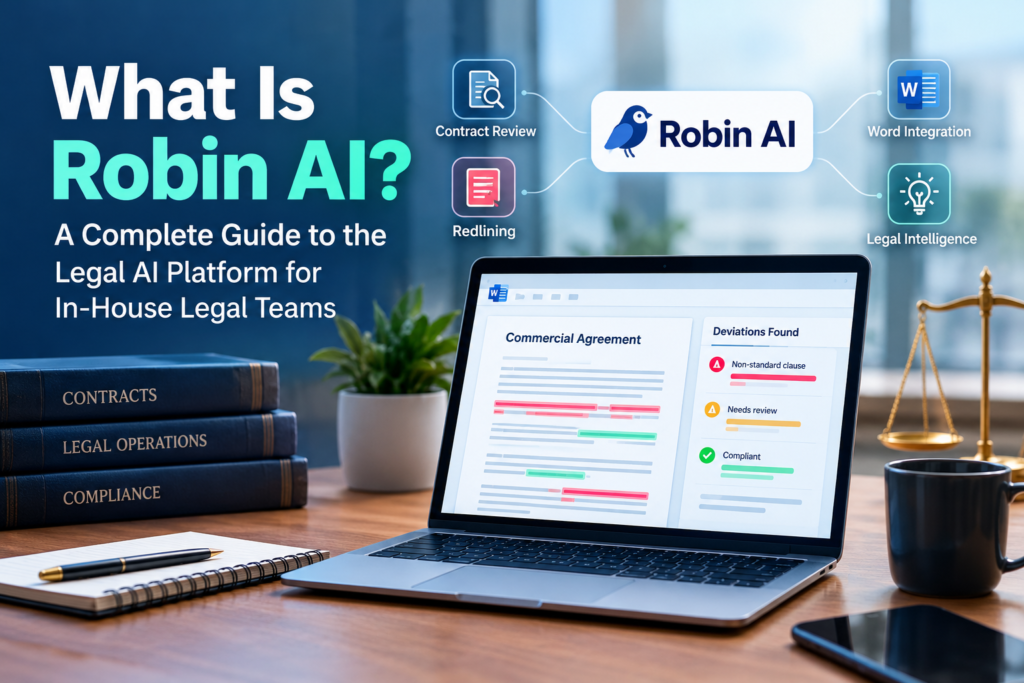
machine-learning researcher James Clough built Robin AI to scan incoming legal agreements, flag clauses that deviated from a company’s playbook, and produce redlined documents in seconds. They were awestruck by how the tool can speed up contract review, as the company claims its copilot reduced
contract review time by 85%, making it roughly six to seven times faster than manual review.
Its direct Microsoft Word integration reduced adoption friction compared with earlier browser-only legal tools. It was once one of the UK’s best-funded legal AI startups and served clients of PwC and PepsiCo.
However, Robin AI completely ceased its independent operations in late 2025 after failing to close a $50M funding round. Scissero acquired its managed services arm, and Microsoft absorbed its engineers. But even today, it remains a valuable case study in AI for in-house legal teams and modern contract-review automation.
Upload or connect contracts:
- Users open a contract in Microsoft Word through Robin’s add-in or upload it directly to Robin’s web workspace.
- Its playbook review works best with clean and non-redlined documents.
- Robin also accepts a .docx contract.
Select an internal playbook or review standard
- You can upload a new playbook or choose an existing one from your Robin Library.
- You can also add some instructions or policy on top of it to guide the AI’s analysis.
- For example, choose an NDA or Supply Agreement playbook; Robin aligns its suggestions with your organization’s preferred positions and fallback options.
Identify risks, clauses, deviations & missing terms
- Robin AI scans the contract to flag non-standard clauses and pinpoint missing terms.
- It can also identify negotiation positions and apply the matching playbook instructions.
- You can also ask direct questions about the contract, such as whether it has an automatic renewal.
Generate redlines in Word & suggested edits
- The Word add-in flags non-standard language in the document against your playbook.
- It produces suggested edits as tracked changes, comments, or highlights, along with explanations for each recommendation.
- With redlines, Robin matches each clause to the playbook to identify changes and, if it doesn’t match properly, proposes compliant revisions.
Review and finalize:
- Lawyers sometimes accept or modify the changes.
- Often, they directly neglect the suggestions and send the contract for approval.
- The review depends on the final copy you want.
Store and monitor contracts:
- Robin covers both proposed agreements and signed-contract portfolios.
- It also extracts structured contract data.
- Teams can store agreements, search key terms, and track renewals, obligations, and compliance deadlines.
Why this workflow matters:
A study found that the average business
loses almost 9% of annual revenue due to poor contract management. For more complex industries, the loss is often 15% or more. With Robin AI, document reviews were handled effectively, and the time required was
reduced by 50–75%, making the process much faster.
Some of the most prominent reasons that stopped the use of Robin AI for contract reviews by legal professionals are as follows:
Vendor Continuity Risk
Legal operations AI buyers need a stable vendor. The company’s late-2025 collapse leaves Robin’s future uncertain. Robin could not complete a 2025 funding round. No public pricing or developer docs were created. Software ownership becomes unclear.
Scissero took its managed-services team in December 2025, and Microsoft hired several employees in January 2026. Conflict still lingers over whether Robin has been fully stopped. This is mainly because its website is still online, and its Terms still name a software supplier. So no one can confirm it’s fully shut down.
Human Review Remains Essential
Robin AI offered useful AI contract review, but legal teams ultimately stopped relying on it. This is mostly because AI output still required deep human oversight. Otherwise,
hallucinations and incorrect extraction risks become inherent to legal LLMs.
Teams needed attorney review for high-value, regulated, cross-border, or unusually complex agreements, which Robin did not provide. Stanford researchers found leading legal research AI tools gave
incorrect information over 17% of the time.
Playbook Quality Matters
Contract redlining works best when the playbook behind it does well. Robin’s legal AI platform often produces inconsistent suggestions regarding weak precedents, vague clause standards, or outdated fallbacks.
Organizations with unclear negotiation positions often have to invest time defining preferred terms before AI review can deliver reliable, consistent results.
Implementation Requirements
Any legal AI platform needs onboarding, data migration, permission setup, integrations, and user training. Budget time for each before expecting measurable savings.
Enterprise deployments may require SSO, API setup, document-management integrations, and a formal security review before rollout.
Robin AI was built with one goal: to help in-house legal teams. Truthfully, it met its responsibilities well. Near the end, frequent hallucinations and incorrect suggestions eroded trust in this legal-operations AI tool.
Hallucinations come with AI tools, and managing them is the company’s job. Robin’s collapse, however, stemmed from a lack of funding and incorrect document pricing.
Its website still exists. Its terms still name a software supplier. The future remains uncertain, but it is fair to expect Robin AI to return in a new form, with new features that make legal professionals’ work easier.
A Junior Journalist passionate about reporting accurate, engaging, and reader-focused news across technology, business, education, health, entertainment, lifestyle, and current affairs. Dedicated to researching reliable sources, verifying information, and producing clear, factual content that follows ethical journalism standards.