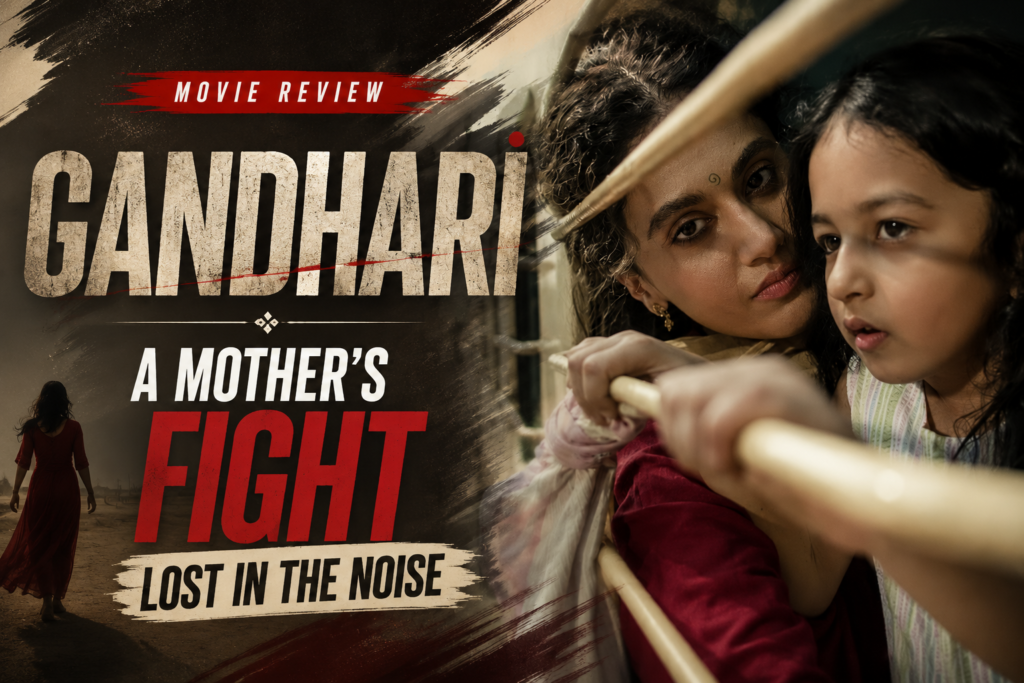
Gandhari Movie Review: A Mother's Fight Lost in the Noise
Ambition drowning in its own excess
Some films fail quietly. Gandhari fails loudly, tripping over its own symbolism at nearly every turn while trying to be a revenge thriller, a feminist statement, and a mythological reimagining all at once. The result is less a coherent story than a pile of half-finished ideas dressed up in prestige clothing.
The story at a glance
Directed by Devashish Makhija and written by Kanika Dhillon, the Netflix film follows Bani, played by Taapsee Pannu, a young mother who loses her vision temporarily during her daughter’s abduction at a railway station. Rather than seeking treatment, she chooses to fake continued blindness as a way of investigating the crime herself, while her husband Gokul, played by Ishwak Singh, pursues a separate lead involving a trafficking ring.
The story unfolds in the fictional town of Joypurra, and the title nods to the Mahabharata’s Gandhari, the queen who blindfolds herself out of solidarity with her husband, a parallel the film spells out rather bluntly through a mentor character rather than trusting the audience to make the connection.
What doesn't work?
The film’s central problem is its inability to settle on what kind of story it wants to tell. It shifts from missing-child thriller to vigilante drama to mythological allegory without ever fully committing to any one register, leaving each mode feeling underdeveloped. Symbolic dialogue meant to carry emotional weight instead lands as hollow, and a plot packed with too many twists in its second half ends up undercutting its own tension rather than building it.
Side characters, including a pair of investigating police officers, exist mainly to service plot mechanics rather than function as real people, leaving much of the supporting cast feeling ornamental.
A screenplay stretched thin
Kanika Dhillon‘s writing has always been divisive, oscillating between ambitious misfires and genuinely sharp character work in her past projects. Here, the ambition curdles into confusion. A subplot involving a mysterious villain revealed only in fragments across the runtime never pays off with any real impact, and a jump forward in the timeline midway through the film is handled in a way that muddles rather than clarifies Bani’s transformation.
The screenplay leans heavily on tropes long associated with “damaged woman” narratives, but never does the work required to make Bani’s arc feel earned.
Performances undercut by the writing
Taapsee Pannu commits fully to the physical demands of playing a woman feigning blindness, and there are brief moments, particularly a tense scene involving a ritual over a child’s body, where her restraint genuinely lands. But the film surrounds her with contrivances that make it difficult for any performance to break through.
Scenes of Bani being physically assaulted are staged with a heaviness that feels more like spectacle than substance, undermining rather than reinforcing the story’s stated interest in trauma and resilience.
A missed opportunity given the director's past work
Devashish Makhija has built a reputation on smaller, more grounded films that explore social prejudice and marginalisation with a level of restraint that Gandhari abandons almost entirely.
Where his earlier work found humanity in bleak, unglamorous settings, this film reaches instead for glossy, mainstream vigilante-thriller beats, training-montage energy included, that sit uneasily against its heavier themes of child trafficking and gender-based violence.
Final verdict
Gandhari wants to be many things at once: a thriller, a mother’s reckoning, a mythological retelling, a feminist statement, but it never earns the right to be any of them. What’s left is a film so busy chasing its own ambition that it forgets to build a story worth following, resulting in a viewing experience that feels more exhausting than moving.
Author: M Jyosri
A Junior Journalist passionate about reporting accurate, engaging, and reader-focused news across technology, business, education, health, entertainment, lifestyle, and current affairs. Dedicated to researching reliable sources, verifying information, and producing clear, factual content that follows ethical journalism standards.