
RAG Hallucinations: The Ultimate Guide to Fixing Costly AI Errors
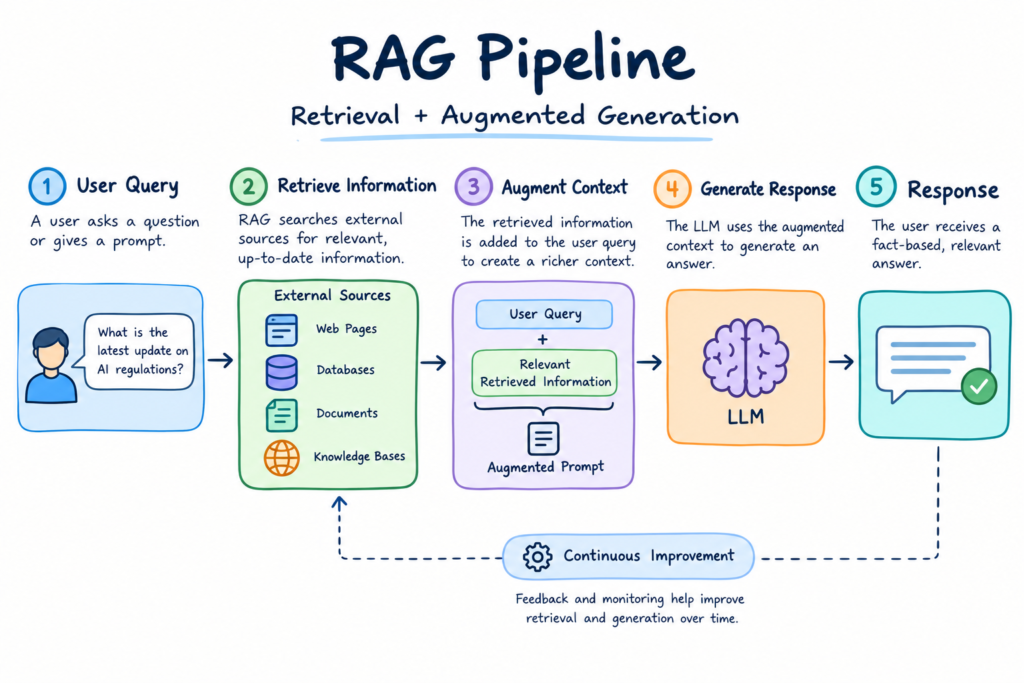
These days, people increasingly use AI tools to search for information and get answers. To generate responses, AI tools pull information from verified sources and compare different pieces of evidence before producing an answer. The process working behind the scenes is called Retrieval-Augmented Generation (RAG).
However, while sourcing information or generating an answer, RAG can sometimes make mistakes and provide incorrect information. This is known as RAG hallucinations. According to recent research, hallucination rates are increasing from 7.9% to 11.3%.
Table of Contents
ToggleBut where exactly does this issue enter the RAG pipeline, and how does it cause AI assistants to generate inaccurate or misleading answers? This blog covers that. You will also learn how to identify and fix these issues.

Why LLMs Still Hallucinate in RAG Systems
So, what does RAG in AI actually help with?
What Do RAG Hallucinations Look Like?
1. Noise Robustness: Retrieving the Wrong Information
2. Negative Rejection: Answering Without Evidence
3. Cross-Source Information Mixing: Combining Facts Incorrectly
4. Citation Mismatch: Linking to the Wrong Source
Where Failures Enter the Pipeline
Document Ingestion and Parsing:
Chunking Strategy:
Indexing and Outdated Versions:
Retrieval and Reranking:
Prompt Assembly:
Generation and Synthesis:
How to reduce RAG hallucinations
Improve the Quality of Retrieved Information
Make your chunks more useful:
Break your content into smaller, meaningful sections. Let some chunks overlap when needed. This keeps related ideas together. But do not make chunks so small that they lose important context.
Use hybrid search:
Do not depend on one search method alone. Combine keyword search with vector search. Hybrid retrieval helps you catch both exact terms and broader meanings.
Rerank the results:
Your first search may not always find the most useful passage. Add a reranking step after retrieval. It can move the most relevant information higher.
Rewrite unclear queries:
Users do not always ask questions clearly. You can first rewrite their query into a more specific search request. This gives your retrieval system a clearer target.
Keep the Context and Prompt Focused
Do not overload the context:
More information does not always mean better answers. Give the LLM only the chunks it actually needs. Too much irrelevant content can make it harder to find the right information.
Tell the model to stay grounded:
Give the LLM clear instructions. Tell it to answer only from the provided sources. If the answer is not available, ask it to say, “I don’t know,” instead of guessing.
Ask for citations:
Make the model connect its claims to specific sources. This makes it easier to check where each piece of information came from. It also helps reduce unsupported answers.
Add Checks Before Showing the Answer
Run a verification step:
Do not always show the generated answer immediately. Add another check first. You can compare the answer against the retrieved sources and catch unsupported claims.
Set a confidence threshold:
Sometimes the system simply does not find enough useful information. Set a minimum confidence level for retrieval. If the score is too low, let the system refuse the answer or send it for human review.
Use guardrails:
Add checks before and after generation. These can help identify problematic queries and questionable responses. The goal is to catch issues before the answer reaches the user.
Conclusion
Author: N. Priyanka
A junior journalist passionate about reporting accurate, engaging, and reader-focused news across technology, business, education, health, entertainment, lifestyle, and current affairs. Dedicated to researching reliable sources, verifying information, and producing clear, factual content that follows ethical journalism standards.
Read More
Working closely with the editorial team, the author contributes news articles, feature stories, explainers, and trending updates while continuously developing reporting, writing, and digital publishing skills. Every article is prepared with attention to accuracy, clarity, and relevance to help readers stay informed about important events and emerging trends.
1. Why can RAG systems hallucinate despite having the correct documents?
2. How do context adherence and completeness differ in RAG evaluation?
3. Why can query rewriting be more effective than prompt engineering?
4. How can two-stage retrieval help reduce RAG hallucinations?
5. Why does chunk-level relevance matter when debugging RAG systems?
Latest

Physical Book Reading vs. Audiobook Listening: Which Should You Choose? You …

Worst Ebola Outbreak in DRC History: 9,000 Cases, 4,000+ Deaths and …

23 Years, One Life-Changing Choice: Why a Microsoft VP Quit the …

Grammy Awards 2027—Ranveer Singh’s Dhurandhar: The Revenge Soundtrack Submitted in 9 …

Why Did Pakistan Declare Emergency in Khyber Pakhtunkhwa? The Full Story …