
RAG Hallucinations: The Ultimate Guide to Fixing Costly AI Errors

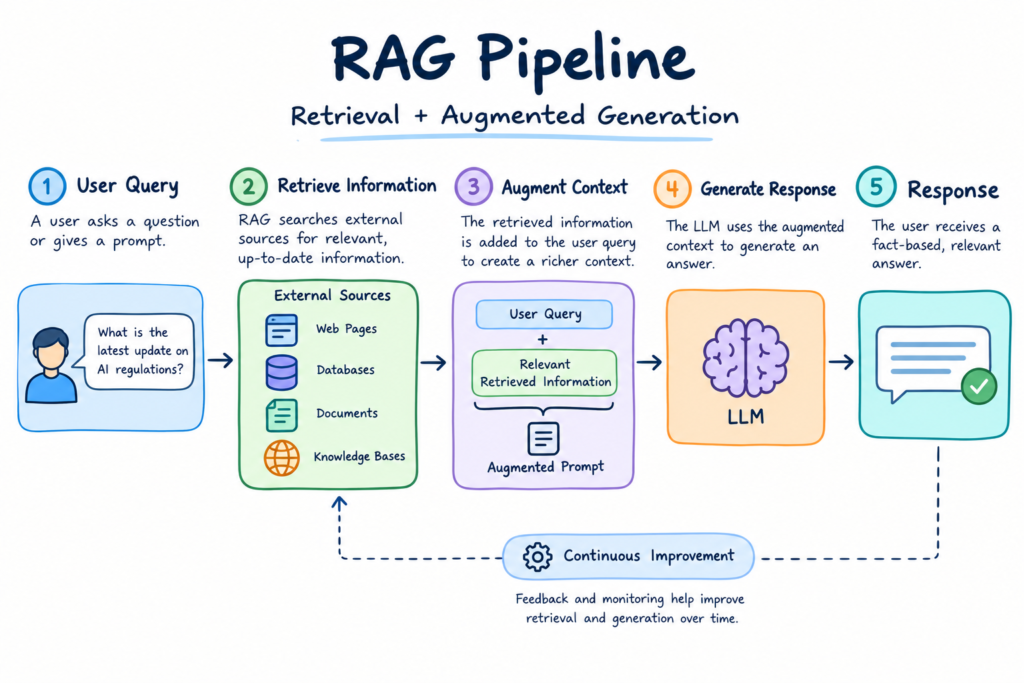
These days, people increasingly use AI tools to search for information and get answers. To generate responses, AI tools pull information from verified sources and compare different pieces of evidence before producing an answer. The process working behind the scenes is called Retrieval-Augmented Generation (RAG).

However, while sourcing information or generating an answer, RAG can sometimes make mistakes and provide incorrect information. This is known as RAG hallucinations. According to recent research, hallucination rates are increasing from 7.9% to 11.3%.

But where exactly does this issue enter the RAG pipeline, and how does it cause AI assistants to generate inaccurate or misleading answers? This blog covers that. You will also learn how to identify and fix these issues.

RAG hallucinations

Why LLMs Still Hallucinate in RAG Systems

Before learning about hallucinations, you should know what LLMs are and how they work.
Well, an LLM is a machine-learning system that understands human language and can generate answers to questions.
 
The problem is not simply that LLMs can provide incorrect data. The bigger issue is that LLMs depend heavily on their training data. For example, Claude, Perplexity, Gemini, and ChatGPT are all built using large language models. Each has its own training process and data sources. When we ask a question, the tool generates an answer based on the information available to its model.

So, what does RAG in AI actually help with?

If an AI tool depends only on its training data, that information can become static. Public information keeps changing, but the model’s original training data may not be updated continuously. This can create problems when users need current information.
But when people want dynamic, evidence-based answers, RAG, or Retrieval-Augmented Generation, has entered the scene. RAG in AI systems helps retrieve relevant information from external sources before generating a response.
 
When a user asks a question, RAG first understands the query. It then gathers relevant information from external sources. It then passes that information to the LLM in a way it can understand and use. This lets the AI work with more current, relevant information.
 
In simple terms, the LLM provides the language-generation capability, while RAG adds external information through retrieval. Together, they can improve accuracy and help reduce hallucinations. However, hallucinations can still occur within this process if the retrieval or generation steps are not properly controlled.

What Do RAG Hallucinations Look Like?

Hallucinations in RAG don’t always look the same. They can take different forms and fall into different categories. Below, we will discuss five common types and explain how each one happens.

1. Noise Robustness: Retrieving the Wrong Information

When users ask a question, RAG gathers a large amount of information. It then needs to identify which part directly answers the user’s query. However, it may sometimes retrieve irrelevant information instead of the most useful part.
 
This mainly happens because RAG works with different information chunks. Some chunks may be topically adjacent or semantically similar to the query. As a result, the system may fetch the wrong chunk without recognizing that it is irrelevant. It can then use that information to generate an incorrect answer.

2. Negative Rejection: Answering Without Evidence

Often, users ask AI assistants questions that have no valid information in the existing sources. So, obviously, RAG can’t retrieve anything that can answer the query with evidence.
 
When this happens, RAG relies on the LLM’s internal, trained knowledge, which is often stale and irrelevant to the query. Instead of saying “no information is available in this context”, the system generates a confident but incorrect response. A perfect case of AI hallucination that misleads users, as they assume the information is accurate even when it lacks evidence.

3. Cross-Source Information Mixing: Combining Facts Incorrectly

If users ask a complex question that requires RAG to check facts from multiple sources, it often leads to mistakes. Why? Because most of the time, it looks at the first relevant chunk and stops there instead of reading the information in depth.
 
As a result, it may combine incomplete details from different chunks and create a completely incorrect answer. For example, one source may describe the support included in one package, while another describes a different package. RAG may mistakenly combine both and present them as a single package. This fabricated information can mislead users and, in some cases, create serious legal problems for companies.

4. Citation Mismatch: Linking to the Wrong Source

RAG hallucinates in citation generation also. Sometimes it provides an answer with an incorrect citation that doesn’t exist or a linked article that is completely irrelevant to the query.
 
Citations work like this: every claim in an AI response should trace to a verified, relevant source. Otherwise, the citation itself becomes a source of misinformation.

Where Failures Enter the Pipeline

RAG hallucinations can occur at several stages of the pipeline, from processing source documents to retrieving information and generating the final response. Here are the key points where these failures can begin:

Document Ingestion and Parsing:

Problems can start before the information reaches the index. Poor parsing may flatten tables, mix up text in multi-column PDFs, or miss scanned pages. This can quietly damage the original information.

Chunking Strategy:

How you divide a document can also create problems. Fixed-size chunks may split related information apart. They can also separate an important condition from the main rule. This leaves the LLM with incomplete context.

Indexing and Outdated Versions:

Old or conflicting documents can create another issue. If outdated versions remain in the index, the system may retrieve incorrect facts. Missing dates or clear version control can make this worse.

Retrieval and Reranking:

RAG may find information that looks relevant but doesn’t answer the question because retrieval memory lacks valid temporal context. It may also fail to rank the most useful passage high enough. The LLM may then rely on its internal knowledge or fill the gap itself.

Prompt Assembly:

Retrieved information still needs to fit into the final prompt. Important passages may sometimes be dropped or shortened because of context limits. The LLM then receives only part of the information it needs.

Generation and Synthesis:

The final step can also introduce errors. The model may struggle with noisy or conflicting information. It may also fail to answer when the available context is insufficient. Without clear instructions to abstain, it may generate an answer anyway.
How to reduce RAG hallucinations
If you want fewer RAG hallucinations in your system, you have to start by improving two areas. First, you need better retrieval. Then, you need tighter control over how the LLM generates answers.
RAG gives an LLM access to external information. But that does not make every answer accurate. Poor data, weak retrieval, and loose generation rules can still create wrong answers. Here is what you can do.

Improve the Quality of Retrieved Information

  • Make your chunks more useful:

    Break your content into smaller, meaningful sections. Let some chunks overlap when needed. This keeps related ideas together. But do not make chunks so small that they lose important context.

  • Use hybrid search:

    Do not depend on one search method alone. Combine keyword search with vector search. Hybrid retrieval helps you catch both exact terms and broader meanings.

  • Rerank the results:

    Your first search may not always find the most useful passage. Add a reranking step after retrieval. It can move the most relevant information higher.

  • Rewrite unclear queries:

    Users do not always ask questions clearly. You can first rewrite their query into a more specific search request. This gives your retrieval system a clearer target.

Keep the Context and Prompt Focused

  • Do not overload the context:

    More information does not always mean better answers. Give the LLM only the chunks it actually needs. Too much irrelevant content can make it harder to find the right information.

  • Tell the model to stay grounded:

    Give the LLM clear instructions. Tell it to answer only from the provided sources. If the answer is not available, ask it to say, “I don’t know,” instead of guessing.

  • Ask for citations:

    Make the model connect its claims to specific sources. This makes it easier to check where each piece of information came from. It also helps reduce unsupported answers.

Add Checks Before Showing the Answer

  • Run a verification step:

    Do not always show the generated answer immediately. Add another check first. You can compare the answer against the retrieved sources and catch unsupported claims.

  • Set a confidence threshold:

    Sometimes the system simply does not find enough useful information. Set a minimum confidence level for retrieval. If the score is too low, let the system refuse the answer or send it for human review.

  • Use guardrails:

    Add checks before and after generation. These can help identify problematic queries and questionable responses. The goal is to catch issues before the answer reaches the user.
RAG Pipeline
Conclusion
RAG hallucinations mostly stem from reasoning gaps in the AI model. These gaps can cause the model to fabricate information or lose track of the user’s intent while processing content through different pipelines.
 
Incorrect citations and incorrectly combined facts are also common sources of hallucinations. However, these errors don’t always enter the final answer at a single point. They can occur during parsing, chunking, retrieval, or answer generation.
 
This means AI hallucinations usually result from a multi-step process. An error at any stage can affect the final response. However, improving the retrieval process can eliminate many common hallucination issues.
 
Start by identifying where the hallucination originates. Then, test and improve your AI chatbot or assistant at that specific stage. You can also improve retrieval and content management while adding stronger output guardrails. Finally, improve your prompts for more reliable responses.

Author: N. Priyanka
A junior journalist passionate about reporting accurate, engaging, and reader-focused news across technology, business, education, health, entertainment, lifestyle, and current affairs. Dedicated to researching reliable sources, verifying information, and producing clear, factual content that follows ethical journalism standards.

Working closely with the editorial team, the author contributes news articles, feature stories, explainers, and trending updates while continuously developing reporting, writing, and digital publishing skills. Every article is prepared with attention to accuracy, clarity, and relevance to help readers stay informed about important events and emerging trends.

Even with correct source documents, a RAG system may retrieve the wrong chunks or misinterpret relevant information. Errors during retrieval, context processing, or answer generation can still lead to hallucinations.
Context adherence checks whether the answer stays faithful to the information provided in the context. Completeness checks whether the answer includes all the important information needed to address the query.
Query rewriting improves the question before retrieval, helping the system find more relevant information. Prompt engineering mainly changes how the model processes retrieved information, but cannot fix poor retrieval itself.
Two-stage retrieval first identifies potentially relevant information and then reranks it for greater relevance. This reduces irrelevant context and gives the LLM more accurate evidence for generating its answer.
Tracking chunk-level relevance shows exactly which pieces of information were retrieved for each query. This helps identify whether hallucinations originate from poor retrieval, irrelevant chunks, or incorrect answer generation.

Leave a Comment

Your email address will not be published. Required fields are marked *

Scroll to Top