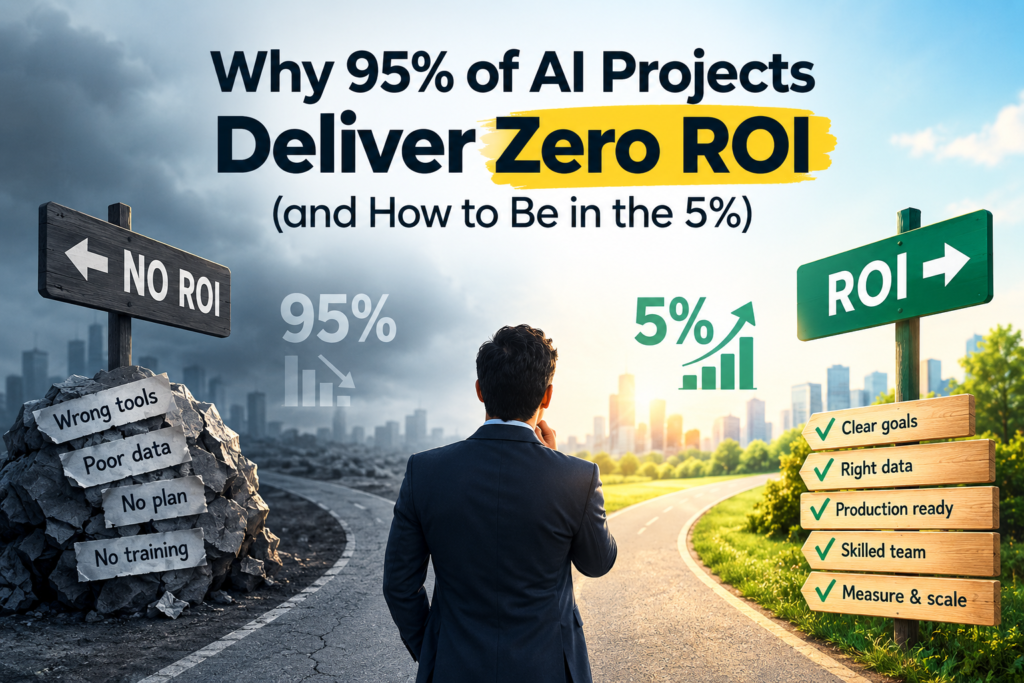
Research shows that about 5% to 8% of enterprise AI projects stand out. These organizations are seeing measurable business value from their AI investments.
So, what are they doing differently?
This blog will explore the strategies behind successful enterprise AI ROI. It will also look at what the 95% of failed projects do wrong and what the successful 5% do differently to achieve measurable AI project ROI.
Start with “Why AI Projects Fail” before jumping into solutions for how to be in the top 5%.
Shiny Tools Selection:
- AI ROI failure often starts when you invest in GenAI pilots without identifying core business problems.
- Investing just because competitors are investing.
- Choosing the tool that can generate high ROI within a few days over a tool that looks attractive.
- Prioritizing transformative AI over an AI tool that can address smaller problems and deliver measurable value within a few days.
Fix: Start with the problem; not with the flashiest AI tool.
Poor Data Quality:
- AI works best with clean, reliable data, but your production feeds it incomplete, messy data.
- According to Gartner, 63% of organizations lack AI-ready data infrastructure, which can slow down the project from day 1.
- Redundant, poorly governed data affects AI output.
- A large part of the project timeline is spent fixing data and planning the budget.
Fix: Allocate around 35-45% of the project timeline to budgeting and data auditing.
Prioritizing Looks Over Operations:
- About 88% of AI project failures happen because teams don’t plan for production from the start.
- The product may look impressive during the pilot but falter under real-world pressure.
- It may lack proper error handling and integrated capabilities.
- Monitoring may be weak or missing, with no real-world edge tests.
The fix: Build for production from day one. Test features in real-world situations and make sure the product can handle errors and pressure.
Chasing Image Over Expertise
- A polished presentation does not always mean strong technical expertise, so choose wisely, not based on large slide decks.
- An AI maturity assessment and roadmap do not guarantee the final product will match the original expectations or solve real business problems.
- Without real metrics, it’s hard to measure an AI implementation’s success.
- Some teams may not provide meaningful support after production deployment.
The fix: Choose partners with proven technical expertise on modern technology stacks and the ability to build the product, deploy it, and help measure its real business impact.
Ignoring Team Training
- Around 70% of AI project success depends on people and processes, not just technology.
- Many companies spend most of their AI budget on technology but give little attention to team adoption.
- Even a powerful AI solution will not deliver value if the team does not know how to use it properly.
- Without proper training and feedback, teams may struggle to adopt the product or use it effectively.
The fix: Train the entire team before launch. Track adoption regularly and create an open feedback loop so teams can report problems, share concerns, identify loopholes, and get help adapting to the new AI solution.
Overinvesting in Marketing
- Businesses often focus heavily on AI-powered sales and marketing experiments.
- Overlooking the areas where ROI can be measured more clearly.
- This makes it harder to see the real AI ROI, especially as marketing results take longer.
- Ignoring back-office automation that can create measurable value by lowering operational costs.
- Businesses keep investing in experiments without knowing which AI initiatives deliver results.
The fix: Automate repetitive tasks and solve everyday operational problems before investing heavily in marketing experiments.
Lack of a Measurement Plan
- Skipping a clear measurement plan during an AI project makes it hard to track productivity gains, cost savings, or other business outcomes.
- Not defining clear KPIs leaves no reliable way to prove whether the AI solution is delivering real value.
- Ignoring regular checkups makes it difficult to know whether the project is meeting its expected goals.
- Failing to measure and analyze results regularly can leave hidden bottlenecks unnoticed and slow down further improvement.
The fix: Create a measurable plan from the beginning. Define clear KPIs and review them often to spot bottlenecks, close loopholes, track progress, and improve results.
Want to know how to be in the top 5% of AI projects with ROI? Start with business outcomes, solve real problems, measure results, and improve the project based on real-world use.
1. Set Business Outcomes
A business should set clear cost-saving or productivity goals before investing in any AI tool or starting an AI project.
2. Identify Real Problems
Identify the problems that slow teams down or affect business results. Build the AI solution around those problems instead of forcing a tool into the existing process.
3. Choose One Specific Flow
Redesign the workflow after deployment, so the AI fits naturally into the process and doesn’t feel like an extra add-on.
4. Build With Real Data
Build the AI project with real business data and test with real-life cases. Never build an AI project only for stakeholder presentations or impressive demos. It should solve a real problem.
5. Measure From Day One
Track savings, error reduction, throughput, accuracy, and other relevant results from the first day. This makes it easier to measure AI project ROI and spot problems early.
6. Train Teams Before Launch
Train the team before launching the AI solution. Humans should act as guardrails until they understand the full system and gain confidence using it properly.
7. Iterate With Reality
Don’t follow a theoretical framework; instead, give the tool to just 5 people. Watch how they use the product and what breaks. Fix those issues before expanding it across the organization.
8. Budget For Change
Around
80% of AI projects fail to meet their objectives after launch. So, keep a separate budget for training, integration, adoption, and unexpected fixes.
9. Track Leading Indicators
Latency and accuracy always matter, so use leading monitoring indicators to check adoption, usage, task completion, and early productivity improvements.
10. Track Lagging Indicators
Measure the final business impact through cost savings, revenue impact, accuracy, productivity, and other financial outcomes. Together, leading and lagging indicators give a clearer view of AI ROI.
AI isn’t failing because the technology is immature. It’s failing because your implementation process is weak. To join the 5%, treat AI as an operational transformation, not a pilot experiment. Start with problems, build for production, measure relentlessly, and invest in people as much as technology.
Author: N. Priyanka
A Junior Journalist passionate about reporting accurate, engaging, and reader-focused news across technology, business, education, health, entertainment, lifestyle, and current affairs. Dedicated to researching reliable sources, verifying information, and producing clear, factual content that follows ethical journalism standards.