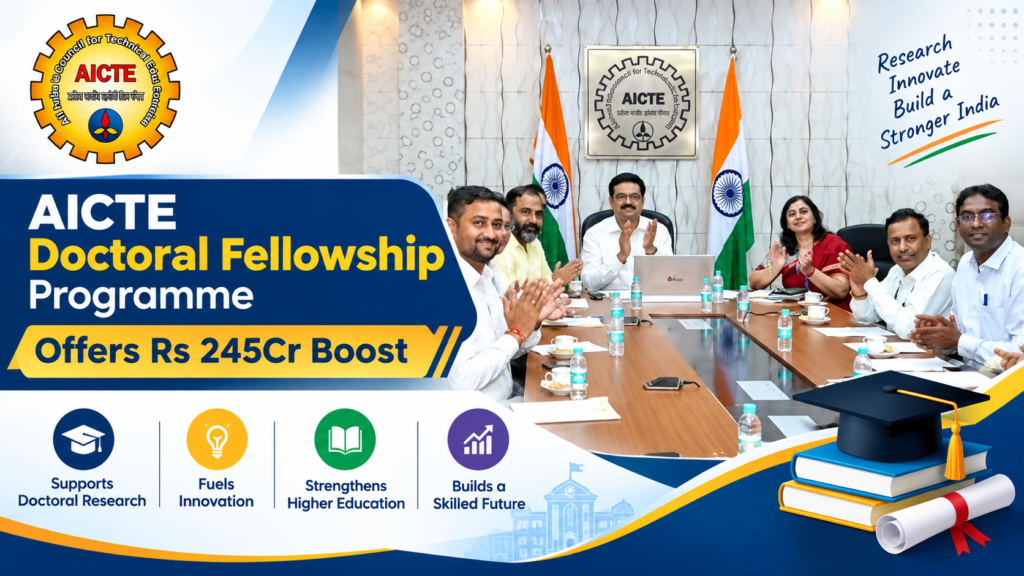
AICTE Doctoral Fellowship Programme Offers Rs 245 Crore Boost to Research
When a PhD Stops Being Just a Thesis on a Shelf
Picture a doctoral scholar spending five years building a genuinely useful invention, only to watch it end up as a bound thesis gathering dust in a university library, never tested outside a lab, never reaching the people it could actually help. That’s been the quiet, familiar fate of a lot of technical research in India, and it’s exactly the gap the government is now trying to close.
On September 4, AICTE Chairman Professor Yogesh Singh and Member Secretary Professor Shyama Rath launched the AICTE Doctoral Fellowship Programme, officially called the AICTE Innovation and Entrepreneurship Doctoral Fellowship Programme, with a financial outlay of Rs 245 crore spread across five years. It’s built specifically to fund research that walks out of the lab and into the real world.
Why Does This Fellowship Matter Right Now?
India produces a large number of doctoral graduates every year, yet the share of that research translating into patents, startups, or deployed technology has historically stayed disappointingly low. Much of that gap comes down to incentives: scholars are typically rewarded for publishing papers, not for building something a market could actually use.
The AICTE Doctoral Fellowship Programme directly targets that mismatch, redirecting funding toward researchers willing to treat commercialisation and societal impact as legitimate outcomes of a PhD, not a distraction from it.
What Does the Fellowship Actually Offer Scholars?
The financial structure is designed to support scholars through the full arc of a doctoral degree, not just the early years when funding is usually easiest to find.
- 150 fellowships to be awarded under the programme
- Rs 60,000 per month, plus applicable House Rent Allowance, for the first three years
- Rs 70,000 per month, plus HRA, during the fourth and fifth years
- Up to Rs 10 lakh as an Innovation Grant per scholar, usable for prototype development, testing, validation, and field trials
- Five-year maximum support window, contingent on satisfactory academic and research progress
Who Is This Fellowship Actually Built For?
Not every doctoral applicant fits the profile AICTE is targeting here. The programme is deliberately narrow in what kind of research it wants to fund.
- Researchers working on problems with a clear path to real-world application, not purely theoretical work
- Scholars interested in eventually commercialising their research through a startup or licensed technology
- Projects tied to technology transfer, where lab research is meant to move into industry use
- Work addressing measurable societal challenges, rather than narrowly academic questions
- Applicants willing to be evaluated on innovation outcomes, not publication count alone
How Does This Compare to Existing PhD Support in India?
Most government-funded doctoral fellowships in India, including long-standing ones from the UGC and CSIR, are structured around academic milestones: coursework, qualifying exams, thesis submission. Very few tie ongoing funding to whether the research shows commercial or societal promise partway through.
That structural difference is what makes this initiative worth watching. By attaching a dedicated Innovation Grant to prototype testing and field trials, it’s effectively asking scholars to prove their research works outside a controlled lab setting, something most existing fellowships never require.
What Happens If the Programme Actually Works?
The real test isn’t the launch event, it’s whether 150 scholars, five years from now, can point to patents filed, startups incorporated, or technologies actually deployed rather than just theses defended. If even a meaningful fraction do, it could nudge how doctoral research gets evaluated more broadly across India’s technical institutions, well beyond just AICTE-affiliated ones.
That shift, from publish-and-shelve to build-and-deploy, is a bigger cultural change than the Rs 245 crore price tag suggests, and one worth tracking over the next five years rather than judging by this week’s announcement alone.
The Bottom Line
The AICTE Doctoral Fellowship Programme won’t fix India’s research-to-market gap on its own, 150 fellowships is a modest number against the country’s total doctoral output. But as a proof of concept for funding research that’s explicitly meant to leave the lab, it’s a meaningful experiment worth watching over the next five years.
Author: M Jyosri
A Junior Journalist passionate about reporting accurate, engaging, and reader-focused news across technology, business, education, health, entertainment, lifestyle, and current affairs. Dedicated to researching reliable sources, verifying information, and producing clear, factual content that follows ethical journalism standards.