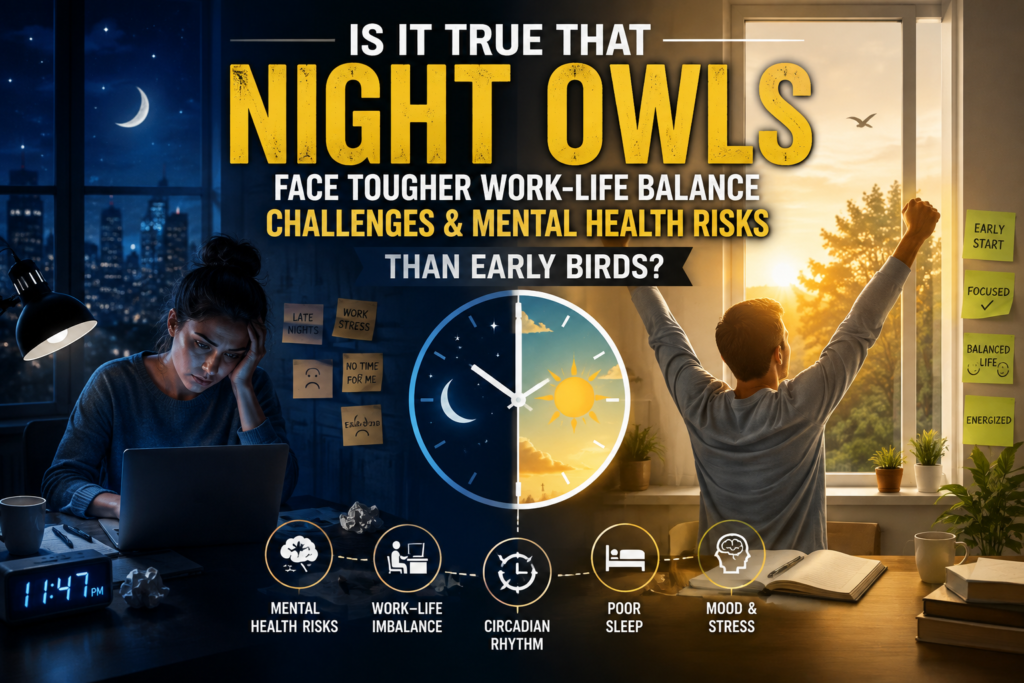
Is It True That Night Owls Face Tougher Work-Life Balance Challenges & Mental Health Risks Than Early Birds?
Are you someone whose focus is at its peak at 10 p.m., but your job calls you at 9 a.m., and every time you feel, “Why now?” Then you’re a night owl living against your own biology.
Most people in society feel lazy, ignorant, unmotivated, and reckless, but that’s not really the case. There’s always a tug-of-war that plays inside them between their internal clock and the world’s schedule.
Their brains are active at night, while society’s work schedule requires them to be active during the day. And this is the point from which a misalignment starts, which completely devastates the night owls’ mental health.
This blog will explain who night owls are, what the latest research says about their work-life balance challenges, the problems they face in daily life, and how they can mitigate them.
What “Night Owl” and “Early Bird” Actually Mean
We all have our own biological clock, known as a
circadian rhythm. It’s like an internal clock that helps us fall asleep at a certain time and wake up feeling refreshed. Each of our body cells maintains its rhythm. When external forces like work or study disrupt it, we often feel agitated and less energetic.
This doesn’t mean a person is lazy; this just means how his internal clock works.
People who prefer staying up late, known as night owls, may face more mental health issues compared to morning people, or early birds.
Research shows night owls find it harder to recover from work stress and are more likely to experience symptoms of mental illness. They often lead less healthy lifestyles, but this doesn’t fully explain their unique challenges with balancing work and personal life.
People who wake up between 4 and 6 a.m. are often called early birds. They can start their work early, reach the office on time, stay motivated while implementing new things, and stay energetic. Their focus and vigor stay high during the daytime and gradually decline, reaching zero as soon as the clock hits 10 p.m.
Night owls are just the opposite. Their focus and energy peak when the clock strikes 10 p.m., then decline until it reaches 10 a.m. That’s when their bodies want rest, and they usually feel sleepy. But we all know office hours peak during the day, especially at 10 a.m., and when someone feels exhausted then, everyone calls them “lazy.”
And yes, for that reason, it is said that Night owls’ work-life balance challenges never end. An evening chronotype is often tied to
elevated depression risk, more severe symptoms, and higher suicidal thoughts.
Recent Research on Psychology That Speaks The Truth
A recent study was conducted among 2,266 working professionals in Finland. In that study, researchers divided people into 3 groups —morning types, evening types, and intermediate types—based on their circadian rhythm.
The researchers constantly monitor their mental health patterns—anxiety and depression levels, whether work-life boundaries remain intact or intrude into personal space, and how one can recover from work-life balance challenges.
You know what its result was? The evening-type people showed greater mental health problems, were more likely to carry the symptoms of anxiety and depression, and mostly intertwined their personal life with work life, which brings more work-life balance challenges to them.
Why The Gap Exists: Mechanisms & Mismatch
Strain develops when the internal clock and the external schedule don’t match. Evening types like to burn the midnight oil, which leaves them needing more recovery time.
Key drivers behind the gap:
- Social Jetlag: misalignment between your internal biological clock and external schedules (early starts, late meetings, school times).
- Poor Recovery: Evening chronotype individuals mostly keep their work-to-home spillover, which is one of the major reasons for their mental health distress.
- Lifestyle Factors: Later bedtimes, light exposure at night, irregular routines, and skipping breakfast can worsen mood and increase anxiety risk.
- Biological Pathways: Circadian rhythm disruption is associated with mood disorders. Sleep disturbances are core features in DSM‑5‑TR diagnoses of depression and bipolar disorder.
Night Owl vs Early Bird Routine: What a Typical Day Looks Like
Both morning and evening types doing night shifts had higher odds of poor mental health, but evening types showed additional vulnerabilities across
several chronic outcomes.
Part of The Day | Evening Chronotype | Morning Chronotype |
Morning wake-up | Harder to wake; groggy if forced early; prefers later start | Wakes easily; feels alert soon after rising |
Morning productivity | Slower ramp-up; better for admin/light tasks | Peak focus window; best for deep work |
Midday energy | Builds through afternoon; may skip heavy breakfast | Strong morning peak; may dip post-lunch |
Evening alertness | Second wind after dinner; best creative/complex work | Wind-down begins earlier; prefers calm activities |
Bedtime | Naturally later; struggles to fall asleep early | Naturally earlier; sleepy by late evening |
Recovery after work | Takes longer to detach; more work spillover into personal time | Detaches more quickly; clearer boundary after work |
Risk profile (by subtype) | Some subtypes: cognitive strengths; others: higher mood/heart risk | Some subtypes: very resilient; others: higher depression risk |
Mental Health Risks: What’s Elevated & For Whom
Evening types, especially extreme evening types, show higher rates of anxiety and depression symptoms and diagnoses.
Later bedtimes are tied to elevated depression and anxiety risk even within the same chronotype, suggesting timing itself matters.
And in later adulthood, it’s tied to a slightly different,
more severe set of symptoms than in younger people. Again, this is a population pattern, not a diagnosis for any one person.
Some evening subtypes also carry more cardiovascular and metabolic risk, with certain effects appearing stronger in women.
None of this means night owls are doomed. It means biology, schedule, and habits can stack the deck, and that stacking is changeable.
Practical Strategies for Night Owls
Part of why night owls struggle more isn’t just the schedule — it’s how they handle emotions. A
2025 study of 157 adults found evening types relied less on cognitive reappraisal (reframing stress before it spirals) and more on expressive suppression (bottling feelings down), and this gap helped explain their higher depression and lower well-being.
That’s good news, in a way: emotional regulation is learnable, which gives night owls a real lever to pull:
For individuals:
- Guard a consistent sleep window that fits your chronotype as closely as possible; avoid big weekday–weekend swings.
- Manage light: get bright light early in your “day,” and dim lights and screens late at night.
- Schedule your most demanding cognitive work during your personal peak hours, and plan recovery time after intense days.
- Use a wind-down routine and limit late caffeine and alcohol to protect sleep quality.
For teams and managers:
- Offer flexible start times or core-hours models to reduce social jetlag.
- Normalize asynchronous work and respect recovery time after late pushes.
- Provide mental health resources that acknowledge chronotype-related stressors.
Closing Thoughts
Night owls aren’t broken; they’re just mismatched. Yes, it’s true that evening chronotype individuals face tougher work-life balance challenges and pose higher mental health risks. But if they work with their body type and follow the practical strategies mentioned in the article above, they will definitely benefit.
Always remember: the fix isn’t to turn into an Early Bird; it’s to better align with your own biological clock.
Author: N. Priyanka
A Junior Journalist passionate about reporting accurate, engaging, and reader-focused news across technology, business, education, health, entertainment, lifestyle, and current affairs. Dedicated to researching reliable sources, verifying information, and producing clear, factual content that follows ethical journalism standards.
Working closely with the editorial team, the author contributes news articles, feature stories, explainers, and trending updates while continuously developing reporting, writing, and digital publishing skills. Every article is prepared with attention to accuracy, clarity, and relevance to help readers stay informed about important events and emerging trends.