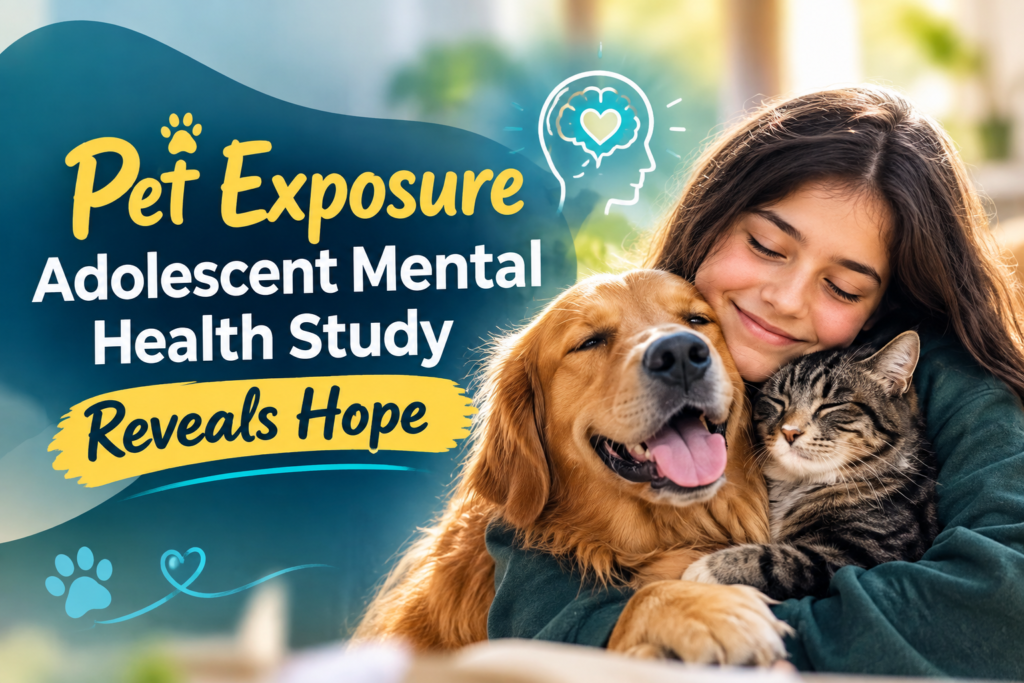
Pet Exposure Adolescent Mental Health: A Surprising Bond
Could a Childhood Dog or Cat Help Protect a Teen’s Mind?
For families who’ve watched a child curl up with a pet after a hard day, a new long-term study offers something worth paying attention to: growing up closely bonded to a dog or cat may be linked to a lower chance of developing a mental health disorder during the teenage years. The research doesn’t prove a pet alone can prevent anxiety or depression, but it adds meaningful weight to a question many parents have quietly wondered about for years.
What the Study Set Out to Discover?
Researchers built this Pet Exposure Adolescent Mental Health study on top of an earlier project that had already found children with pet dogs scored lower on anxiety measures than children without one.
To see whether that early pattern held up over time, the team followed 571 young people from childhood into adolescence, tracking their medical records for diagnoses of anxiety, depression and ADHD over an average of nearly eight years.
Roughly eight years after the original study, researchers also reached out to families directly to gather more detailed information on how much time each child had spent with a pet and how emotionally attached they were to it.
Key Findings: How Pets Were Linked to Lower Risk
The results pointed to a consistent, if modest, protective pattern tied to pet exposure:
- Children who had a pet dog at the start of the study were 26 percent less likely to receive any mental health diagnosis by adolescence, after adjusting for other factors
- Nearly one in three participants, 191 out of 571, received a mental health diagnosis during the study period, with anxiety being the most common at 52 percent of cases
- Simply having a pet dog wasn’t linked to a lower risk of anxiety specifically, or to more severe cases requiring psychiatric medication, only to the broader category of any mental health diagnosis
- Ongoing exposure to a pet dog throughout childhood showed a similar, borderline protective trend, though it didn’t reach full statistical significance on its own
What Made the Difference: Attachment Over Ownership
The most striking part of the Pet Exposure Adolescent Mental Health findings wasn’t ownership itself, but how closely a child bonded with their pet. Key results from this part of the analysis included:
- Children most strongly attached to their pet, whether a dog or cat, had a 43 percent lower risk of developing an anxiety disorder
- The same highly attached group also showed a 36 percent lower risk of receiving any mental health diagnosis overall
- These attachment-based effects held up even after accounting for household income, one of the strongest confounding factors identified in the study
- Pet cats alone, without strong attachment, weren’t linked to the same protective pattern as dogs were
Why Pets Might Offer This Protective Effect
Researchers involved in the study pointed to a few possible explanations, while stressing that none have been confirmed. One theory involves the body’s stress-response system, since interacting with a pet has been shown in other research to raise oxytocin levels and lower cortisol, the hormone most associated with stress.
Another proposed idea involves pets contributing to a child’s gut microbiome in ways that may indirectly influence brain development and emotional regulation. The study itself wasn’t designed to test either mechanism directly, so both remain reasonable but unproven explanations for the pattern observed.
Limitations Worth Keeping in Mind
The researchers were careful to note that this was an observational study, not a controlled experiment, meaning it can’t prove that pets directly caused better mental health outcomes. It’s possible that children in calmer, more stable environments are simply more likely to both have a strongly bonded pet and experience fewer mental health struggles, rather than the pet itself driving the effect.
The study also relied partly on parents recalling years of pet exposure from memory, which can introduce some inaccuracy, and it was conducted in a region with limited access to mental health services, which may have affected how consistently diagnoses were captured.
What This Means for Families?
While this research doesn’t turn pet ownership into a prescription for mental wellness, it does suggest that the quality of a child’s bond with a pet may matter more than simply having one in the house. For families already considering a pet, or reflecting on the one they have, the findings offer a reassuring, evidence-backed reason to nurture that relationship, alongside, not instead of, professional mental health support when a child needs it.
Author: M Jyosri
A Junior Journalist passionate about reporting accurate, engaging, and reader-focused news across technology, business, education, health, entertainment, lifestyle, and current affairs. Dedicated to researching reliable sources, verifying information, and producing clear, factual content that follows ethical journalism standards.