Is Your Carbon Footprint Killing Your Profits? It’s Time to Adopt Green Practices
Your monthly P&L looks fine, but day-by-day your carbon footprint is climbing; does this sound familiar? If so, you’re moving in the wrong direction and may be missing a profit strike.
Across industries,
94% of senior business leaders say climate-related disruption has already caused financial losses in the last two years, with 30% reporting setbacks over $1 million.
At the same time, companies that implement sustainability well can see profitability gains of up to 21%, sales lifts of up to 20%, and firm value increases of up to 36%.
In other words, your emissions aren’t just an “environmental issue.” They’re a business issue. This post breaks down how sustainable business practices can trim your carbon footprint and your costs without turning your company into a preachy eco-campaign.
Sustainable Business Practices: How Big Is Your Business Carbon Footprint?
Your carbon footprint is the total greenhouse gas emissions you release into the environment to run your business. Most frameworks split it into three buckets:
- Scope 1: Emissions you directly create—fuel burned on-site, company vehicles, and generators.
- Scope 2: Emissions from the electricity, heat, or steam you buy.
- Scope 3: Everything else—business travel, employee commuting, purchased goods, logistics, waste, and more.
For many businesses, Scope 3 is the biggest slice but also the hardest to measure.
Some Not-So-Comfortable Numbers
Why “Going Green” Isn’t Just PR Anymore
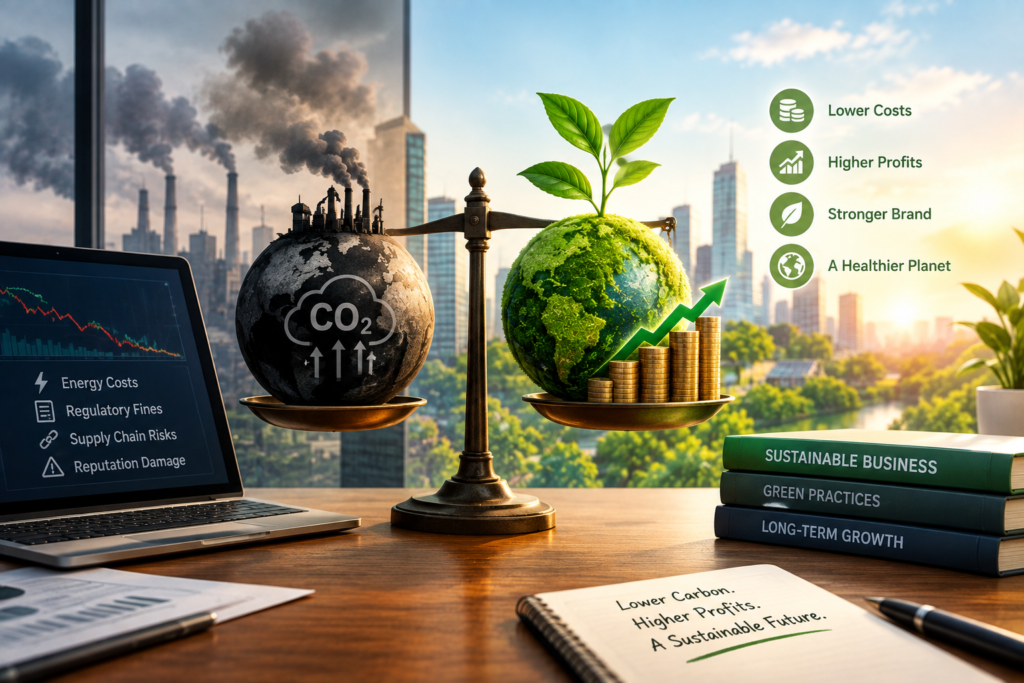
Climate Risks Are Hitting the Bottom Line
Climate-related disruption is no longer theoretical.
94% of business leaders report climate-related financial losses in the past two years. These show up as:
- Higher energy and raw material costs.
- Supply chain delays and downtime.
- Regulatory fines, compliance costs, and insurance premium hikes.
Sustainability Brings a Competitive Edge
Businesses that embed sustainability into their core operations outperform competitors in ROI, earnings, confidence, and compliance. One McKinsey report noted that top-performing ESG companies generate roughly
2.6 times the returns of ESG laggards.
That means sustainable business strategies are now part of smart financial planning, not just CSR reports.
Top 5 Benefits of Maintaining Sustainability in Business
Energy Efficiency
Energy costs drive a huge chunk of emissions, and it’s also the easiest place to start making changes. A few smart changes here pay off fast.
- One PUE study reports a 16% monthly saving, which is nearly $262K a year.
- LEED buildings burn about 25% less energy than regular ones.
- You will notice the maintenance bills would drop by 20% with green certification.
- Sustainable business practices can shave about 10% off retrofits in year one.
- LEDs and better HVAC controls pay for themselves within a year or two.
Waste, Water, Materials
When you reduce waste and water, you’re also cutting your bill. Less used means less spent, and less spent means less emitted.
- You’ll see about 15% lower costs by cutting food waste and energy.
- Start following the 3R formula—reuse, recycle, redesign; this step will cut material costs by up to 30%.
- Try to buy local and sustainable products; this can cut transport emissions by 20%+.
- Local suppliers also make your supply chain tougher to break.
- Every bit you don’t use is money saved, and emissions avoided.
Software and Digital Ops Count Too
Your servers and cloud accounts aren’t emission-free either, even if you can’t see the smoke. And there’s real money hiding in that mess.
- You can reduce your carbon footprint with green software trials that cut emissions, costs, and energy by 20–35%.
- You optimize code, cloud workloads, and storage, and you’ll also see a substantial carbon footprint reduction.
- Unused cloud instances quietly burn cash and carbon, so try to eliminate them.
- Compress your data to shrink both your footprint and bill.
- You need to maintain an efficient architecture; this one lever can pay you back immediately.
Revenue, Brand, and Talent Upsides
Cutting costs is only half the win. Sustainability also pulls in more business, and the money follows.
- You will notice customers are more concerned about the planet and more inclined to choose eco-friendly products.
- Younger talent puts more effort into cleaner and sustainable business startegies.
- B2B clients now push suppliers hard to cut their Scope 3 emissions.
- Sustainability isn’t just a passing trend; it’s become a strategic business necessity.
- Firms that shift their traditional business practices to greener ones will see stronger returns, especially in heavy-emissions sectors.
Risk Reduction and Future-Proofing
Carbon footprint reduction doesn’t just save you money but also protects you from bigger problems in the future. It’s less about optics and more about staying ahead.
- You must track your emissions; this will help you reduce your future taxes.
- Lock in renewable energy contracts and avoid the swings in fossil-fuel prices.
- Diversify your suppliers and regions to weather climate-driven supply shocks.
- You must plan for climate-risk compliance and execute it step by step.
- Always start with small steps and take bigger leaps later, so regulations don’t catch you off guard.
In short, reducing your carbon footprint improves business profitability by making your cost base more predictable and your operations more resilient.
Simple Ways to Start
Sustainable business practices reduce operating costs, but starting with everything can enhance your business expenses. You can’t fix what you’re not tracking, so before making changes, establish a baseline. Here’s where to begin:
- Track your scope 1, 2, and 3 emissions using any carbon calculator.
- Analyze the numbers first, then choose 2-3 strategies; start with those instead of a 10-year plan.
- Swap in LED lighting and smart HVAC controls; these may seem small but can drive real savings.
- Push for renewable energy contracts or green tariffs wherever you can.
- Are you in a food business? Then start using compostable packaging and call for local sourcing; these steps can help reduce waste-related emissions and energy use.
- Never forget to monitor energy use, waste, and purchases monthly; treat it like you treat revenue.
Common Myths Holding You Back
Common Myths | What The Facts Say |
“Sustainability Is Too Expensive” | Yes, for green buildings, you’ll pay maybe 2–5% more upfront, but that gap closes fast. Lower energy, water, waste, and maintenance bills chip away at it. |
“It’s Only for Big Corporates” | Not true. 67% of SMEs are already seeing real savings from sustainability moves. You don’t need a massive budget |
“We’ll Do It Later” | 94% of business leaders have already taken a financial hit from climate disruption. Waiting doesn’t protect you from that; it just means you have to deal with rising costs. |
Quick Checklist: Is Your Business Lagging on Carbon?
Every month, you need to ask some basic questions about your business’s carbon footprint, and obviously answer them honestly. Here is a list of some questions:
- Do you actually know your Scope 1, 2, and 3 emissions?
- Have climate disruptions hit your costs or operations in the last 24 months?
- Are you tracking energy, waste, and materials monthly, the way you track revenue?
- Do your procurement decisions factor in carbon and lifecycle costs?
- Are you missing out on grants, tax incentives, or green financing?
Final Move: Stop Guessing & Start Cutting
Your carbon footprint rises, and you stay silent- this shouldn’t be the scenario. It’s a major problem for the planet and its people. So every business owner should stay aware. Track your emissions and start following the 3R formula. Optimize your code and cloud storage, and also make sustainability a strategic part of your business.
Stay away from prevalent myths and start with small, simple ways. Every month, sit with yourself and ask a few basic questions about your business’s carbon footprint, and answer them honestly. Maintaining all these sustainable business practices helps you save on costs, energy, and cloud storage.
A smaller carbon footprint = better revenue and recognition. Your P&L will notice. So will the planet.
Author: N. Priyanka
A Junior Journalist passionate about reporting accurate, engaging, and reader-focused news across technology, business, education, health, entertainment, lifestyle, and current affairs. Dedicated to researching reliable sources, verifying information, and producing clear, factual content that follows ethical journalism standards.